Tuesday, March 17, 2020

Scientists are arguing that our lives will change in the upcoming year


Dr. Michael Osterholm

The other night I viewed a ninety-minute Youtube interview with infectious disease specialist Dr. Michael Osterholm. Listening to that interview, I began to realize that my life and the lives of the entire working class of the world will change in this coming year. The next day, I read from other reliable sources that the essence of Dr. Osterholm’s argument is reasonable.

While the media is arguing that we must contain Covid-19 (coronavirus), Dr. Osterholm is arguing that millions of us will become infected with this disease. Saying this, the death rate for the disease is about two percent. That would mean that hundreds of thousands of people in this country would have a fatal outcome. The elderly, and that includes me, would have a fatality rate of ten to twenty percent. Dr. Osterholm estimates that all of this will unfold in the next four to seven months.

The captains of the corporate world are afraid

Well, it has been a few days and I’m still trying to begin to absorb this information. As you might imagine, it is difficult to even think about what this new reality will mean. So, in this blog, I will only focus on one part of the interview with Dr. Osterholm.

In that interview Dr. Osterholm mentioned that he had a meeting with representatives of some of the largest corporations. Those executives were interested in how Covid-19 (coronavirus) will affect their businesses.

Dr. Osterholm said that after he reported on the anticipated effect of the disease, those executives acted like “scared six-year-old children” who were afraid to walk in shadows. So, a question to be asked is: Why were these so-called titans of the corporate world panic stricken, when given a rational view of what will be happening in the upcoming months?

We can begin to answer that question with a fact those corporate executives live in routine denial of. This is that workers create literally all the wealth in the world. Because of this disease, many corporations will shut down and many workers won’t be producing wealth anymore. Why is this so depressing for those executives?

Because of the routine functioning of the capitalist system, corporations are driven do be obsessed with three objectives.

They must constantly look for ways to sell more and more commodities. This is why they spend about $200 billion in advertising every year.

Then, they are obsessed with cutting costs. This is why corporations invested vast amounts of money to eliminate manufacturing jobs in this country, and build factories in nations where the prevailing wages are between $1 and $10 per day.

Then, they must go into astronomical debt. Today, from what I see, investments in derivatives are valued at hundreds of trillions of dollars.

In order to enforce those routine policies in the world, the government invests hundreds of billions of dollars in the military every year. One effect of the deteriorating conditions in this country is the skyrocketing number of people living in prison. While the United States government criticizes other governments, this country has the largest prison population in the world.

When we look at the totality of this reality, we might imagine why those executives became panic stricken, when they learned of what the world will face in the upcoming months. The source of the wealth that has given them opulent lifestyles is evaporating. While there have been recessions and depressions in the past, the current crisis is profoundly different from anything we have experienced.

The absolute fear expressed by those executives makes it clear that they have no idea of how to rationally deal with this crisis. On the other hand, I read a report that Italian unions are calling for a general strike of all enterprises except for essential services. That call, in my opinion, demonstrates clearly how the needs of working people are different from the profit drive of corporations.

How would a worker’s government respond to this crisis?

Thinking about the call for a general strike in Italy raises the question: How would a worker’s government respond to this crisis? In my opinion, today Cuba has a worker’s government and their history is worth looking at.

In 1959 the present Cuban government took power. Cuba at that time had about 500,000 sugar cane workers who only had work for about three months every year. Under those conditions, the literacy rate was about 23% and health care was unknown to many on the island.

After the revolution, the government organized a massive literacy drive and every Cuban learned how to read. That literacy drive was the foundation for the Cuban health care system.

Today Cuba has about three times more doctors, per capita, than the United States. Cuban infant mortality is lower than in the U.S. While about 400,000 hospital beds have been eliminated in the United States since 1980, Cuban doctors have been treating some of the poorest patients all over the world.

We can also say that in the United States research for a vaccine or cure for coronavirus was stalled because corporate officers didn’t think this research would be profitable. During these same years, Cuba has been developing their own interferon treatment. Cuban interferon has been shown to be effective in keeping coronavirus patients alive while their immunological systems fight this disease.
  
What would a worker’s government do today?

In order to answer that question, I believe we need to start with the question of what is needed. First, we need to have an international response aimed at making it a top priority to test every person in the world for Covid-19. A top priority needs to be that the results of all those tests need to be done immediately. Clearly the infrastructure for all of this doesn’t exists, but all of humanity can be organized to make this happen.

A priority would be to provide for the needs of everyone in the world. These needs include food, housing, electricity, water, health care, and communication. I think we need to consider that the workers who will be providing these services will be risking disease and or death from Covid-19.

For these reasons, I think it is rational that no one should be prevented from having the things we need because we cannot pay. There are workers who will be willing to work, and there are resources available to provide for our needs.

Capitalists have different ideas

While medical experts call for people to isolate themselves and practice “social distancing,” Philadelphia Mayor Jim Kinney has different ideas. This is his point of view: “We can’t shut everything down,” because “we may be healthier, but the economy will tank, and we can’t have that.” In other words, Mayor Kinney thinks that many people need to die so that some of the most affluent people in the world can continue to live in opulence.

The central priority of capitalists is profit. Capitalists need to routinely make payments on exorbitant debts in order to stay in business. The top priority outlined in the City Charter of Philadelphia is to make payments on loans to bondholders. Some of those bondholders are, no doubt, some of the most affluent people in the world.

So, when corporations are not able to afford to keep their businesses open, they will close down and eliminate millions of jobs.

This state of affairs was dramatized in the film, Too Big To Fail about the stock market crash in 2008. William Hurt played the role of Henry Paulson, who was the Secretary of the Treasury at the time.

In the film, there is a scene with the character of Henry Paulson and his wife sitting in their back yard in the middle of the night. Paulson’s wife asks him: What is the matter?

Paulson replied that if the stock market crashes, in two weeks there won’t be milk in the stores.

This is how the political economic system of capitalism works.      

In the past, workers toiled for capitalists because the paychecks we received allowed us to get some of the things we need and want. With the economy going into a tailspin, those days are beginning to end. Today workers need to take control over the economy, and this will become more clear every day.

What is our history

How can this happen when the labor movement in the United States has been in retreat for over fifty years? In order to answer that question, perhaps we might look at our history.

For thousands of years humanity lived in tribal societies where we attempted to survive by dealing directly with the natural environment. The basic strategy in those days was to work in communal societies where the labor of everyone was appreciated. Because of that reality, women’s work was essential to human survival, and women were seen as equals to men.

Then, came the hundreds of years of slavery in the Greek and Roman Empires. Work was no longer viewed as a means of sustaining life, but as a form of inhuman drudgery forced on unwilling workers. The goal of the slave was not to make work easier, but to become free.

Then, came the years of feudalism where serfs toiled on the farms of the nobility. Those serfs were not allowed to leave that land throughout their lives. Just as with the system of slavery, feudalism went into a severe decline. Then, it was pushed aside with revolutions.

The birth pains of the capitalist system consisted of genocide against Native Americans, chattel slavery, horrendous working conditions, as well as unimaginable wars. Out of those horrors came the international working class.

Our class has been struggling since the birth of capitalism all over the world. We ended chattel slavery in the Civil War. We then ended Jim Crow segregation with the civil rights movement. The horrendous conditions workers used to routinely experience have been improved. We went on an international campaign to stop the war against Vietnam.

This is our history. I clearly don’t know how we will deal with the current crisis. What I do know is that when we look at our history, we have the capacity to come out of this crisis much stronger. As they used to say in the civil rights movement: “Keep your eyes on the prize. Hold on.”

If we can dare to struggle, we can certainly dare to win.  

Friday, March 13, 2020

Red Zone – Cuba and the battle against Ebola in West Africa


By Enrique Ubieta Gómez
Pathfinder Press – 2019

Reviewed by Steven Halpern

The coronavirus has alerted the world that communicable viral diseases are a threat to humanity. Within weeks, this virus has spread throughout the world and is now in Pennsylvania.

To get an idea of how deadly viruses can be, there was the so-called Spanish Flu of 1918 that probably originated in Kansas. This influenza killed more people in the United States than all the wars of the twentieth century combined. Philadelphia was one of the cities with the highest death toll at about 1,200. The world death toll from this influenza might have reached fifty million.

So, the question is: What is an effective strategy of fighting these viruses? The Cuban journalist Enrique Ubieta Gómez begins to answer that question in his book, Red Zone – Cuba and the battle against Ebola in West Africa. This is not only the report on an effective effort to combat Ebola, this is a genuinely heroic story.

In the year 2014, the Ebola virus was ravaging the West African nations claiming the lives of thousands in Sierra Leone, Guinea, and Liberia. The President of Sierra Leone, Dr. Ernest Bai Koroma, sent a letter to the Cuban President Raúl Castro asking for medical assistance. What kind of medical assistance would be needed to combat the Ebola virus?

First, we need to understand that Ebola is a highly communicable disease where skin contact can lead to a fatal infection in just a matter of days. So, volunteers for this mission could very well die because of an exposure to Ebola. Then, there was the question of telling one’s family that they would be volunteering for a mission that could cost their life. Then, there was the real possibility that medical volunteers could bring the virus back to Cuba and expose eleven million Cubans and the entire Western Hemisphere to a lethal virus.

For these reasons, the developed nations contributed money to fight Ebola, but there were few volunteers willing to risk their lives. Cuba rapidly recruited 256 highly experienced medical volunteers to battle the virus in the three West African nations. Why was the relatively small nation of Cuba able to mobilize these volunteers to fight Ebola?

A central goal of the present Cuban government has been to elevate or assist the poorest Cubans as well as the indigent people of the world. Because of that perspective, Fidel Castro spoke at the United Nations and reported that Cuba would eliminate illiteracy on the island in just a few years after the Cuban Revolution. At that time, the Cuban literacy rate was about twenty-three percent.

The new Cuban government mobilized young and older volunteers to go to remote areas of the island to teach everyone how to read. As a result, Cuba overcame illiteracy in just a few years. That literacy drive paved the way for the fact that today Cuba has about 85,000 doctors, perhaps more doctors, per capita and any other nation in the world. 

As early as 1962, when Cuba only had about 3,000 doctors, they were giving medical support to the nation of Algeria. Then, in the year 2005 Cuba mobilized 1,500 doctors and nurses to assist victims of Hurricane Katrina. This contingent was named Henry Reeve after a New Yorker who volunteered to join Cuba’s independence revolution against Spain in the nineteenth century. The United States government refused to accept this assistance for hurricane victims.

Then, the Henry Reeve Contingent went to Pakistan where they set up 32 field hospitals to treat patients living in an area where that experienced a devastating earthquake. At the time of the Ebola outbreak in 2014, there were 32 Cuban medical brigades operating in nations throughout Africa. Between the years of 1960 and 2014, Cuba had extended medical solidarity to 109 nations.

Once the Cubans arrived in West Africa they were met with several seemingly impossible challenges. In order to treat Ebola patients, the Cuban volunteers needed to wear hermetically sealed body suits. They needed to do this in temperatures of 122 degrees Fahrenheit. By merely touching the outside of this body suit after treating an Ebola patient, a medical practitioner could be exposed to this deadly virus.

While there is no known cure for Ebola, patients can survive the disease if their symptoms are treated. However, because of the centuries of colonialism and underdevelopment, the populations of these West African nations have a history of poor health, high rates of infant mortality, as well as large percentages of illiteracy.

While the Cuban doctors were effective in saving many lives, many of their initial patients died from the effects of Ebola. So, the initial response of some people living in this region was not to trust those white doctors in strange suits who treated people who died. The Cubans needed to establish relations with the people to establish the trust that necessary to save people’s lives.

Because of the six-month effort by the Henry Reeve Contingent in West Africa, the Ebola virus was greatly contained. There were no reported cases of Ebola in Cuba after the medial volunteers returned to the island.

The New York Times ran a story on October 18, 2014 titled “Cuba’s Impressive Role on Ebola.” This article stated: “The global panic over Ebola has not brought forth an adequate response from the nations with the most to offer. While the United States and several other wealthy countries have been happy to pledge funds, only Cuba and a few nongovernmental organizations are offering what is most needed: medical professionals in the field…”

This article is an exception from the generally hostile articles in the press about the nation of Cuba. Enrique Gómez’ book Red Zone gives us a completely different view of the island. Today as the coronavirus is spreading around the world, the Cuban Henry Reeve Contingent in West Africa gives us a clear example of how to deal with these lethal viruses.

Steven Halpern lives and writes in Philadelphia. He was a member of two Cuba International May Day Brigades in 2017 and 2019. There he learned about the Cuban reality with hundreds of Brigade members from around the world. Steven Halpern has also had letters published in the Philadelphia Inquirer for over thirty years.                        

Sunday, March 8, 2020

Celia Sánchez—an Organizer of the Cuban Revolution


She was raised in Pilón,
a small town in the province
of Oriente, Cuba.
Her mother died when she was a child.

Her father, Manuel Sánchez,
came from an affluent family
and became a medical doctor.
He also raised Celia, her brothers and sisters.

Unlike most doctors in Cuba at that time,
Dr. Manuel Sánchez treated
those who could not pay.
Many of these were the ones who cut sugar cane.

His patients suffered from having bad teeth,
to tuberculosis, to malnutrition,
to gunshot or knife wounds, or the effects of alcoholism.
He also delivered the babies.

Celia became her father’s assistant.
She learned the names, illnesses, and problems of all the patients.
She joined her father making house calls
on horseback riding into the mountains.

She made sure that on the day of the Kings holiday,
that every child had a present.
This became her mission,
and the people loved her.

She liked to read the fashion magazines,
and wore bright red lipstick.
Even after the Revolution triumphed
she wore high heels with her fatigues.

Her father taught Celia about Cuban history
He taught her to appreciate the beauty of the mountains.
He taught her how to do deep-sea fishing.
At night, on the beech, with her friends, she ate her catch of the day under the stars. 

Where she lived, the rural guards had absolute power.
They could take whatever they wanted.
They raped women,
and resistance was met with torture or death.

Celia had supported political campaigns
aimed at making meaningful change.
These efforts failed,
Then, Celia discovered the July 26 Movement.

She learned that she needed to change
from being an independent woman,
into a disciplined revolutionary,
who strictly followed orders.

Initially her leader was Frank País.
But life in the city became increasingly dangerous
and government forces murdered País.
Sixty-thousand attended his funeral in Santiago.

These forces arrested Celia.
Her fate would have been almost certain torture and death.
But she saw an opportunity and escaped,
hiding in the cover of the marabu

Celia then joined Fidel and the revolutionaries in the Sierra Maestra.
She was a small woman,
but managed to march
for many miles each day in the mountains.

Then, she looked for the children who needed medical attention.
She spoke with the patents asking for their permission,
so revolutionary doctors could treat the young ones.
She also asked the revolutionary priests to preside over weddings.

The forces of repression had tremendous resources.
They used aircraft in a relentless effort
to find the revolutionaries.
But they failed.

Celia organized the construction of a small town in the mountains,
that served the needs of the revolution.
The town was hidden by a canopy of trees.
From this base, the revolution advanced.

Although the army of the people was outnumbered
and had fewer resources,
their spirit became more powerful
than those who were motivated by money.

One of her first acts as a leader of
the revolutionary Cuban government
was to airlift toys to the children of the Sierra.
She had not forgotten them.

When Cuba was attacked by mercenaries
supported by the United States at Playa Girón,
Celia played a prominent role
in defending the island.

She brought many of the campesinos
from the Sierra to Havana
where they learned skills
and improved their lives.

The women received new clothes,
makeup, and hairdos
at the beauty parlors.
Yes, this was a new day.

From the beginning Celia and the revolutionaries
understood the importance of health care and education.
Today, Cuba probably has more doctors and teachers
per capita than any other nation in the world.

We might consider that the United Nations
estimates that about 29,000 children die every day
due to preventable diseases.
Cuba has one of the lowest infant mortality rates in the world.

Celia Sánchez, along with Vilma Espin, and Haydee Santamaria
are examples of how women
have the potential to organize
to transform the world.

Today, more and more working people
see instability of the world.
Celia Sánchez taught us that we can work to build
a world where human needs are more important than profits.

Thursday, March 5, 2020

Women and the liberation of humanity


They played a crucial part in every
human advance in the history of the world.
Yet, the media routinely portrays them
as sexual objects, who need the protection of men.

They have given birth to every
human being in the history of the world,
Yet politicians argue that they should not
have the right to decide if and when to become a mother.

Their inner beauty has inspired
humanity all over the world.
Yet, advertisers invest billions of dollars
in an attempt to make women feel insecure about their appearance.

Yes, corporations are driven to take
trillions of dollars from women
who purchase jewelry, cosmetics, mascara,
and extravagantly expensive clothing.

For all their many contributions,
the emotional and physical abuse of women
is a continuing fact of life
in the world today.

So, while women only receive
70% of the wages of men,
the most affluent people living in the world,
have more money than they could use in 100 lifetimes.

Then, there are governments that argue
that we need to go to war
and destroy entire nations,
so they can pretend to defend democracy in the world.

Some of those who make these arguments
happen to be women.
Yes, there are affluent women in the government,
and on the boards of corporations.

So, now you might have an idea why there are many women
who don’t like this situation.
Now you might understand why   
there are women dedicated to changing this relationship.

There was Mother Jones
who organized the movement
to end child labor
for all time.

There was Ida Wells,
who organized to stop the murder
or lynching of people
who happened to have a dark skin color.

There was Celia Sanchez
who helped organize the Cuban Revolution,
so all the Cuban people will have their own government,
with the right to education and health care.

Yes, women represent a potentially
explosive force in the world today.
Sooner or later women will unleash that power,
and the world will learn the true beauty of half of the human race.  

Sunday, February 23, 2020

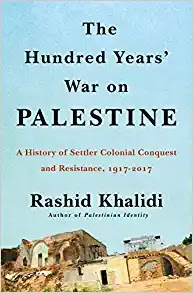
The Hundred Years’ War on Palestine—A History of Settler Colonial Conquest and Resistance, 1917 – 2017


By Rashid Khalidi

A review by Steve Halpern

The news media in this country portrays the conflict between the government in the state of Israel and the Palestinian people as one unending and seemingly unsolvable disagreement. Rashid Khalidi portrays this same conflict as a hundred years war against the indigenous people of the state of Israel who are known as Palestinians. While I’ve read many books on this topic, my opinion is that Khalidi’s history of this conflict is the most comprehensive and informative.

Khalidi has a unique perspective to this subject. His family has been involved in the struggle against the colonization of Palestine since the signing of the Balfour Declaration in 1917. Khalidi lived in various areas of the Middle East for much of his life. He and his family experienced the Israeli bombing of Lebanon in 1982. He was one of the Palestinian negotiators to the Oslo Accords that were signed in 1993.

Perhaps the best way to summarize Khalidi’s book is to list the timeline of the colonization of the nation that was once known as Palestine.

1917—The signing of the Balfour Declaration—In 1917 Palestine was a colony of Britain. At that time Jewish people consisted of about six percent of the population.

At this same time, there was a Zionist movement that was demanding a homeland for Jewish people in Palestine to counter the anti-Semitic acts against Jews in the world. We might keep in mind, that at this time the majority of the Jewish diaspora opposed Zionism and favored a struggle to protest anti-Semitism wherever it arose. Clearly Jewish people did not want to uproot their lives and move to a nation that was overwhelmingly occupied by people who were not Jewish.

Under those conditions the secretary of state of foreign affairs in Britain, Lord Balfour, issued the following sentence:

“His Majesty’s government view with favour the establishment in Palestine of a national home for the Jewish people, and will use their best endeavours to facilitate the achievement of this object, it being clearly understood that nothing shall be done which may prejudice the civil and religious rights of existing non-Jewish communities in Palestine, or the rights and political status enjoyed by Jews in any other country.”

So, with these few words, the British government approved of the mass displacement of the indigenous population of Palestine and the colonization of Jewish people who, at that time, lived mostly in Eastern Europe. This declaration also ignored the over two-thousand year history of the various nationalities who had lived on Palestinian land.

To fully appreciate the imperial arrogance of this declaration, we might present an analogy. Imagine if the world’s super-power endorsed a plan to remove the people of London from their homes and replace them with people who lived in another part of the world. This is how many Palestinians, who were not mentioned in the Balfour Declaration, viewed this document.

The British suppression of the 1936-1939 Palestinian uprising—Palestinians had endured the colonization of their homeland by Turkey and then Britain for decades. The disgust with their colonizers erupted in a general strike of Palestinians in the year 1936. That general strike developed into an armed revolt in 1937.

The British responded to those uprisings by mobilizing 100,000 soldiers, along with armored vehicles and aircraft, to confront Palestinian resistance. Khalidi argued that 10% of the male Palestinian population were either killed, wounded, imprisoned, or exiled by the British during those years.

This British repression of Palestinian aspirations paved the way for the Zionist movement to colonize Palestine. In the words of the fascist Zionist Ze’ev Jabotinsky: “Zionism is a colonizing venture and, therefore, it stands or falls on the question of armed forces.”

The 1948 establishment of the state of Israel, otherwise known as the Nakba, or the Catastrophe—In the year 1947 the United Nations General Assembly, in effect, agreed with the ideas expressed in the Balfour Declaration. This called for the partition of Palestine into separate Jewish and Palestinian sectors.

The establishment of the state of Israel received much international support because of the Nazi holocaust of six-million Jews. While the political movement known as Zionism had little support before the Nazi concentration camps, this idea became very popular after the Second World War. However, the idea that Palestinians would be expelled from their homeland was not known to much of the world at that time.

I happen to be Jewish and attended Hebrew school until the age of thirteen. While the state of Israel was routinely glorified in that school, I only learned of the word Palestinian when I was nineteen years old.

The fascist Zionist organizations of the Stern Gang and the Irun carried out a terrorist policy of murdering Palestinians in an effort to remove them from their homeland. These efforts were made possible with massive British support. Without that support the Israeli colonists would have not been able to overcome Palestinian resistance.

As a result, about 80 percent of the Palestinian people or a population of 1.3 million were forced to leave their homeland and made refugees. The effect on Rashid Khalidi’s family was typical of many Palestinian families. Khalidi has cousins in several Arab countries, many European nations, as well as the United States.

The 1967 War— By 1967 the United States had become the primary supporter of the state of Israel. U.S. aid to Israel created a military imbalance in the Middle East that allowed Israel to defeat the armed forces of Egypt, Syria, and Jordan in six days. Khalidi reported that in 1967 he was living in New York City where he viewed the near unanimity of the support for the continued Israeli colonization of Palestine.

The advancing Israeli armed forces were supported by the United Nations resolution SC 242. This allowed for the further expansion of Israeli territory on the Palestinian homeland.

The former Israeli Prime Minister Golda Meir rationalized the theft of Palestinian land with her seemingly insane statement: “there were no such thing as Palestinians... They do not exist.”

As Palestinian national resistance developed, the Israeli Mossad began to carry out a systematic and covert campaign to assassinate Palestinian leaders. This campaign had an effect of weakening Palestinian resistance.

The Israeli War Against Lebanon—Lebanon was one of the nations where Palestinians became refugees. This was where the Palestine Liberation Organization had its headquarters.

The Israeli armed forces formed an alliance with a rightwing Lebanese organization known as the Phalangists. Because of this support these Phalangists had from both Israel and the United States, they carried out a series of raids on Palestinian villages where thousands were murdered.

Henry Kissinger was the Secretary of State of the United States during this largely one-sided war. His goal was to “break the back” of the Palestinians. In this effort Kissinger recruited the government of Syria to back the war against Palestinians.

1979 Camp David Egypt-Israeli so-called peace treaty—Faced with the U.S. supported defeat of the PLO in Lebanon, the Israeli government of Menachem Begin felt free to negotiate a so-called peace agreement with Egyptian President Anwar Sadat. These discussions did not include representatives of the Palestinians and were destined to be a complete failure. This agreement was brokered by the administration of the U.S. President James Carter.

The Carter Administration was adamant about excluding the Palestinians from these talks. At that time Andrew Young, who had been a leader of the civil rights movement, was the United States representative at the United Nations. When Young merely had a discussion with the PLO, he was terminated from that position.

This treaty secured Israeli control of the occupied territories and removed Egypt from supporting the Palestinians.

The war against Lebanon continued—With the so-called peace agreement with Egypt in hand, the Israeli government felt free to accelerate its war against Lebanon. This meant that with the support of the United States, Israel bombed defenseless Palestinian refugee camps indiscriminately. This was a flagrant violation of Article 25, Annex to the Hague Convention adopted in 1899.

In the end, the PLO negotiated a withdrawal from Lebanon in 1982. The PLO’s only demand was that the remaining Palestinians in Lebanon would be protected. After the PLO left Lebanon, the Israeli air force carried out bombing raids that caused 500 casualties.

At this point, U.S. Secretary of State Alexander Haig was the one who supervised the crucial support Israel needed to conduct their genocidal war.

The Palestinian Intifada—Although the PLO had been defeated in Lebanon after a determined resistance, the demand for Palestinian human rights continued. Starting in 1987 an uprising of young and old Palestinians erupted in the occupied territories. Around the world the news media published photos of Palestinian children throwing rocks at Israeli tanks.

Since the tanks failed to quell the uprising, Israeli Defense Minister Yitzhak Rabin ordered the construction of batons that he felt would be effective to, “break their bones.” These batons were then used to break the bones of thousands of Palestinians. For Israel, the use of these batons was important because when the news media reported on Palestinian deaths, the Israeli government felt this was not good for their public relations.

Because of this Intifada, the world began to see the struggle of Palestinians as being a biblical David going up against a heavily armed Goliath.

The Oslo Accords—Largely because of the changing perception of Israel in the world, a new set of negotiations were organized. This time the Palestinians were included. However, as with the history of the war against Palestinians, the Israeli government had all the advantages.

The PLO was also weakened because of the fact that it did not oppose the Saddam Hussein organized Iraqi invasion of Kuwait. Although Kuwait was not a strong supporter of Palestinian rights, many Palestinians had lived in that country and managed to make a living. This position further isolated the PLO.

As a result of the Oslo Accords, the PLO recognized the state of Israel. Israel, for the first time accepted the fact that there were indeed a Palestinian people, and that the PLO represented their interests.

Ironically, during those same years that Israel was negotiating with the PLO, the Israeli government was also giving significant support to the organization known a Hamas. The support to Hamas was a deliberate attempt to splinter Palestinian resistance.

Rashid Khalidi argued that agreeing to the Oslo Accords was a mistake made by the PLO. Before this agreement, Palestinians were allowed to travel throughout Israel. After Oslo, Palestinian movement was curtailed by a series of checkpoints. Palestinians might have to wait hours at these checkpoints before being allowed to enter Israel.

Before the Oslo Accords the Palestinian neighborhood of East Jerusalem was an important part of the occupied West Bank. After Oslo, Palestinians needed to go through checkpoints in order to enter East Jerusalem.

Before Oslo, there was no wall separating Jews from Palestinians. After Oslo, Israeli settlements in the West Bank mushroomed, and now 11% of the Israeli population lives in the occupied West Bank. Today a wall, along with electrified wires separate Israel from the Occupied Territories.

Before Oslo, Israeli wars were primarily against the neighboring nations of Lebanon, Jordan, Egypt, and Syria. After Oslo, Israel conducted several wars against the Palestinians living in the occupied territories.

These wars were exacerbated by the firing of missiles by the organization Hamas into Israeli civilian areas. Because of U.S. support, those missiles only were responsible for a relatively small number of deaths, but there was no excuse for firing missiles into civilian areas.

Hamas made the mistake of rationalizing the missile firings with the fact that the peaceful negotiations did nothing for the Palestinians. So, they made the mistaken rationalization that they needed to fire rockets into civilian areas. Those actions only intensified the conflict. However, Hamas won elections in the occupied Gaza Strip, largely because of the PLO failure in the Oslo Accords.

Rashid Khalidi quoted an Israeli official who stated the goal of the Israeli government in the Oslo Accords. He argued that he wanted the PLO to resemble the Phalangists in Lebanon and become a repressive force against the Palestinians.

President Donald Trump’s so-called “Deal of the century.”—Rachid Khalidi quoted the late Palestinian writer Edward Said who explained how the exploitation of Palestinians is unique. “This a unique colonialism that we’ve been subjected to where they have no use for us. The best Palestinian for them is either dead or gone. It’s not that they want to exploit us, or that they need to keep us there in the way of Algeria or South Africa as a subclass.”

This statement underscores the theme of the hundred years of war against Palestinians from the Balfour Declaration to Donald Trump’s so-called “Deal of the Century.” That so-called deal would merely intensify the worsening conditions for Palestinians in what was once their homeland.

As in the past, the Arabic governments in the nations surrounding Israel have joined together to betray the interests of Palestinians. They are asking Palestinians to, in effect, commit suicide and participate in this charade, falsely claiming to promote peace in the region. However, the Palestinian people are not going away.

What is a Marxist viewpoint on the Middle East?

Rashid Khalidi pointed out that in the year 2018 the Israeli Knesset declared in the Constitution that Israel is a “Jewish state” and that anyone who is not Jewish is a second-class citizen. Khalidi argued that this perspective must be reversed if there is ever to be peace in the Middle East.

The workers throughout the world have learned through numerous experiences that basic equality among people is a necessity for humanity. The question remains: What is the strategy to achieve genuine peace and equality in the Middle East?

Abram Leon was a Marxist who was born in Warsaw, Poland, lived in Belgium, and executed by the Nazis in the Auschwitz Concentration Camp at the age of twenty-six. He wrote a history of Jewish people titled: The Jewish Question. Although Leon never lived to see the establishment of the state of Israel, he clearly understood the theoretical bankruptcy of the Zionist movement.

Leon argued that anti-Semitism is a product of capitalism. During the feudal epoch, Jews were defended by royal families who used the Jewish community as merchants and money lenders. With the advent of capitalism, Jews became scapegoats for the continual war against working people in the continuous drive to maximize profits.

The development of the nation-states of the world was a result of capitalist expansion. The establishment of the state of Israel came about because of the deterioration of capitalism. One of the signs of this deterioration was the murder of about one third of the Jewish population in the world by the Nazis.

The British colonialists used the Jewish community to divide the people of the Middle East just as they promoted divisions between Catholics and Protestants in Ireland, and Pakistanis and Indians in Asia.

Given this reality, Leon made the following observation: “One must be stricken with an incurable judicial cretinism to believe that the creation of a small Jewish state in Palestine can change anything at all in the situation of Jews throughout the world, especially in the present period.” The seventy-year history of the state of Israel, along with the increasing anti-Semitic acts mean that these words of Abram Leon have never been truer.

Leon also argued that since anti-Semitism is a product of the capitalist system, that system needs to be replaced in order to advance the genuine interests of both Jews and Palestinians. How would this happen?

In their Communist Manifesto Karl Marx and Frederick Engels argued that the capitalist system has a “disease.” That disease is the crisis of “overproduction.”

We viewed the effects of this “disease” in the depression of the 1930s and the stock market crash of 2008. These events don’t make sense to rational people. If people are willing to work and there are available commodities, why do millions of people see their jobs eliminated, and then have difficulties finding equivalent employment?

Because of the routine functioning of capitalism, corporations are obsessed with cutting costs and selling more and more commodities. This means that sooner or later workers do not purchase the commodities capitalists are selling. When people aren’t buying a sufficient number of commodities, capitalists are not gouging out profits, and they have no reason to invest. The effect is recessions and then depressions.

Understanding this reality, we can see that the routine billion-dollar gifts Israel receives from the United States will one day come to an end. When this happens, the Israeli economy will not be able to sustain itself. So, what is to be done about this reality?

Vladimir Ilyich Lenin was the leader of the Bolshevik Party that organized the Russian Revolution. Before that revolution, Czarist Russia was known as a “prison-house of nations.” Many different nations experienced routine discrimination.

Lenin argued that the Bolsheviks needed to support the unconditional liberation of all these nations. Failing to do this would mean that the Russian Revolution would have been an impossibility. The name of the new nation established by the Bolsheviks was the Union of Soviet Socialist Republics. This name reflected the fact that the new revolutionary government supported the unconditional liberation of all the nations in the USSR.

Today I believe that all Israeli citizens need to understand that the only way for them to escape the horrors of capitalism and anti-Semitism is to support the unconditional liberation of Palestinians.

For various reasons, the Russian Revolution was betrayed by Joseph Stalin. Stalin organized to murder the entire leadership of the revolution. One of those leaders was Leon Trotsky, who Stalin initially exiled from the USSR.

Trotsky needed to find a nation that would give him asylum. He argued that the right of asylum needs to be supported by workers in every nation in the world.

After their expulsion from their homeland, Palestinians lived in many nations. Although this was clearly not the preferred option, living abroad allowed the Palestinian diaspora to survive.

Today Israeli law states that Jews all over the world have a right to Israeli citizenship. As Abram Leon argued, that reality has done nothing to reverse anti-Semitism in the world. As long as Israel is used as a repressive force against Palestinians, Jewish people will never have a meaningful homeland in that nation.

A few months before the Russian Revolution, Lenin was living in exile in Switzerland where he gave a speech. He argued that he didn’t think that the Russian Revolution would happen in his lifetime. As we know, that is exactly what did happen. Why?

Millions of Russian soldiers were being murdered in a senseless war against Germany. The Russian people experienced starvation conditions in a nation that had vast areas of fertile farmland. Under those conditions, the Russian people began to understand that they needed to think differently about politics, and under the leadership of the Bolsheviks they did what had been viewed as unthinkable, and took power away from both the Czar and the capitalists.

Today the United States gives more financial and military aid to the state of Israel than any other nation in the world. We can ask the question: Why does the U.S. give so much aid to a nation of seven million people?

In my opinion the answer to this question flows from the fact that all corporations in the world are completely dependent on a continuous flow of oil. The nation of Israel is located in the middle of the region where most of the oil is located.

Because of the nature of capitalism, both Israelis and Palestinians will go through a time where they will need to think differently about politics. I have confidence that they have the potential to make the entire Middle East a place where the human dignity of all workers and farmers becomes the absolute priority.